Did Madison Fight a Revolution So We Could Fund Religious Diet Plans?
James Madison warned against compelled religious funding. Here’s what the Founders actually believed about liberty and state neutrality and CAIR’s recent call for Ramadan accommodations in ICE detention facilities.
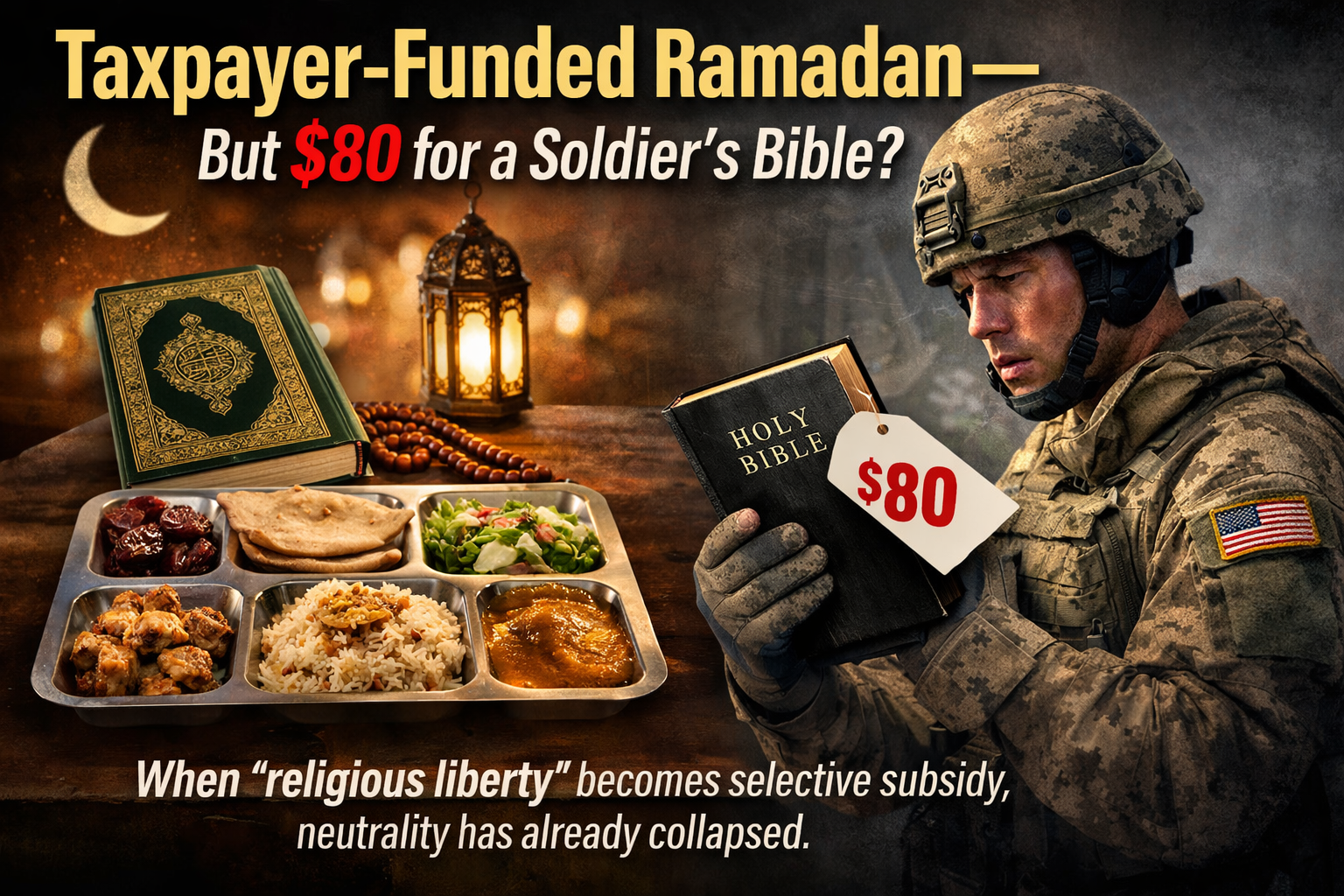
Image representing James Madison’s opposition to taxpayer-funded religious assessments
In that release, CAIR urged Texas ICE facilities to provide:
Special meal schedules for Ramadan fasting,
Religious texts (including Qurans in various languages),
Prayer beads and mats,
Designated prayer spaces,
Dietary and medication adjustments,
Expanded access to Muslim chaplains,
and warned that failure to provide such accommodations could violate constitutional protections as well as federal statutes like RFRA and RLUIPA.
CAIR framed these accommodations as necessary religious protections.
Accountability Matters frames the issue differently.
This is not a question of hostility to religion.
This is a question of constitutional structure.
The Constitutional Line Madison Drew
James Madison answered this question in 1785.
In his Memorial and Remonstrance Against Religious Assessments, Madison opposed a proposal to tax Virginians in order to financially support Christian clergy.
He did not object because the tax favored one denomination.
He objected because government had no authority to compel citizens to fund religion at all.
He warned that even the smallest tax to support religion:
“is itself a dangerous abuse of power.”
He insisted religion must be left to “the conviction and conscience of every man,” not to civil authority and not to the public treasury.
He warned that once government assumes the power to fund religion:
“Who does not see that the same authority… may establish with the same ease any particular sect… in exclusion of all others?”
Madison’s point was structural:
Government is not competent in matters of religion.
Government may not levy taxes for religious support.
Government neutrality is preserved by restraint — not by equal sponsorship.
The Taxation Problem — Crockett’s Line
This is not merely a religious liberty question.
It is a taxation question.
Davy Crockett explained the principle clearly when Congress proposed federal charity expenditures:
“We have the right, as individuals, to give away as much of our own money as we please; but as members of Congress we have no right to appropriate a dollar of the public money.”
It was not theirs to give.
It is not ours to give.
Public money belongs to the People — not to Congress, not to agencies, not to advocacy groups, and not to chaplain partnerships.
When CAIR calls for taxpayer-funded religious compliance — meal restructuring, devotional materials, religious articles, sectarian scheduling — it is asking civil authority to do precisely what Madison rejected: levy public funds to sustain religious exercise.
Compelled religious subsidy was unconstitutional in 1785.
It does not become constitutional because the religion is different.
When Neutrality Becomes Selective — And Inverted
Let’s stop pretending this is abstract.
A member’s son volunteered to serve this country in uniform.
He swore an oath to the Constitution.
He stood ready to deploy wherever ordered.
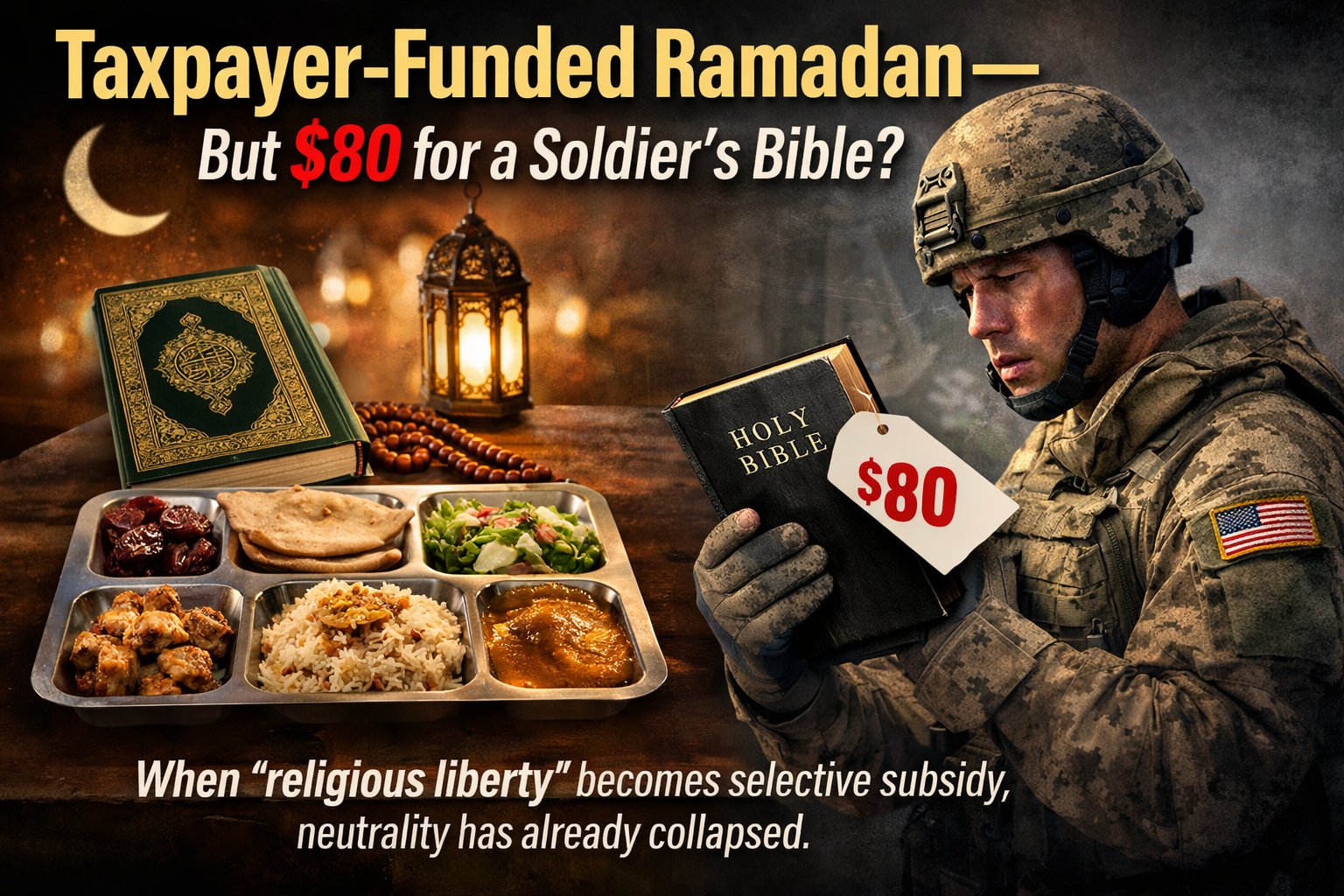
And when he sought a Hebrew Bible, he was told it would cost him $80.
At the same time, the federal government funds halal meal programs for detainees — including foreign nationals held in ICE custody.
Read that again.
A volunteer American soldier must pay for his own religious text.
A foreign national detainee receives taxpayer-funded religious dietary compliance.
That is not neutrality.
That is inversion.
Where Do We Draw the Line?
Do soldiers rotate off watch five times daily for sectarian prayer while others maintain the line?
Do we fund sacramental wine? Kosher kitchens? Liturgical calendars? Ritual objects?
Do we finance dietary codes for one faith while charging others for their sacred texts?
Do we fund Islamic religious compliance in detention while telling a volunteer American service member to open his wallet for his own Scripture?
This is not hostility to any religion.
It is hostility to selective subsidy.
If taxpayer-funded halal meals are constitutionally required, then taxpayer-funded provision of a Hebrew Bible to every service member who requests one must be equally required.
If funding one religious observance is establishment, funding all religious observances is establishment.
And if it is “not ours to give” for charity, it is certainly not ours to give for sectarian compliance.
The Constitutional Order Is Not Compassion-Based
The Constitution does not require government to subsidize religious observance.
It requires government:
Not to prohibit it.
Not to compel it.
Not to establish it.
The moment the State finances religious compliance as religious compliance, it crosses from non-interference into sponsorship.
Madison was unequivocal:
Civil authority is not competent in matters of religion.
It may not determine which sect’s practices merit public funding.
It may not convert public revenue into sectarian accommodation.
Neutrality does not mean equal funding of faith.
Neutrality means civil authority stays out of religion altogether.
The State may not prohibit Ramadan.
But it is not constitutionally required to finance it.
Closing
CAIR is free to advocate for Muslim detainees. That is their right.
But advocacy does not redefine the Constitution.
The same document that protects Ramadan protects the conscience of a member’s son serving in uniform.
If CAIR believes taxpayer-funded halal compliance is constitutionally required, then it must also accept that denying a volunteer American service member access to a taxpayer-funded Hebrew Bible is constitutionally indefensible. And if compelled religious subsidy is wrong in one direction, it is wrong in all directions.
The line Madison drew is the only safe line: government must neither suppress religion nor finance it.
Neutrality is not equal funding of faith.
Neutrality is the refusal of civil power to enter religion at all.